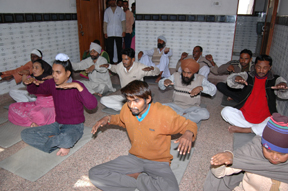
NADA Protocol is part of Prerna De-addiction center Rajasthan


  • Acupuncture clinic- In January 2006, to make drug de addiction treatment more effective, acupuncture clinic was established here with the help &; NADA India foundation. Ear acupuncture is done for treatment of drug addicts, it involves gentle placement of three small sterilized disposable needles on specific sites on each ear. The recipients sit quietly in a group setting for 45 minutes, relaxing or meditating.
  • It simply decreases craving for alcohol, or drugs & withdrawl  symptoms
  • It reduces anxiety, agitation, insomnia.
  • Clients prone to anger or violence discover opportunities for inner peace.
Nada India started a training module to train members working in the field of drug deaddiction. Our centre has been established as an acupuncture training centre supported by NADA India. In this training programme .The acudetox technique in taught through a 70 hours training and internship programme. Such trainees gain certificate as Acu detox specialist (ADS). The ADS,s do not do differential diagnosis or full treatment as acupuncture is only one component of substance abuse treatment. The value of acupuncture lies party in the relief of withdrawal symptoms, but crucial goal is to prepare  the clients to participate effectively in other therapies, Ear acupuncture has been found to improve patients treatment readiness and  overall treatment retention.ROOP CHAND SIDANA Center has been using NADA ear acupuncture for addiction treatment and well-being

http://drroopsidana.com/biodata.html

Popular posts from this blog

IAADS SMART Commitments Presented at the Second Global Summit on Traditional Medicine

The Indian Association of Acupuncture Detoxification Specialists (IAADS) submitted its SMART Commitments in support of the WHO Global Traditional Medicine Strategy 2025–2034 , which were formally acknowledged at the Closing Ceremony of the Second Global Summit on Traditional Medicine , held in New Delhi on 19 December 2024 . Submitted by Dr. Ajay, President of IAADS , the presentation took place in the presence of the Honourable Prime Minister of India , the WHO Director-General , and the Honourable Union Ministers for Health and Family Welfare and AYUSH , highlighting India’s leadership in ethical, community-based Traditional, Complementary and Integrative Medicine (TCIM) . The Indian Association of Acupuncture Detoxification Specialists (IAADS) is honoured to share that its SMART Commitments were among sixty global commitments submitted in support of the World Health Organization’s Global Traditional Medicine Strategy 2025–2034. These commitments were formally acknowledged during t...

The Future of Quitting: NADA Protocol and AI Transform Tobacco Cessation

Tobacco Cessation: From Inner Calm to AI-Driven Solutions —  A Path Shaped by NADA protocol In an era increasingly influenced by artificial intelligence and digital innovations, tobacco cessation strategies must evolve to address both emotional and technological dimensions. While AI-powered conversational solutions offer promising avenues to assist individuals in quitting tobacco and preventing non-communicable diseases (NCDs), the most profound change often begins internally.  As Dr. Michael O. Smith, founder of the National Acupuncture Detoxification Association (NADA), aptly stated, “NADA acupuncture teaches us to relax from the inside out.”  This internal transformation is crucial. Individuals, particularly adolescents, youth, women, and marginalized communities, often grapple with stress, trauma, or stigma, making discussions about tobacco use, mental health, or domestic violence challenging. To surmount these barriers, a fusion of compassionate, community-based met...

Indianizing Prevention and Restoring Human Dignity in Drug Response

  From Confrontation to Compassion: Indianizing Prevention and Restoring Human Dignity in Drug Response By *Suneel Vatsyayan The journey from confrontation to compassion in India’s drug response is not merely a professional reflection—it’s a personal one. It began for me in 1985, when I met a 16-year-old boy struggling with petrol sniffing. Brought by his mother to the Observation Home for Boys near Delhi Gate, this moment left an indelible impact. It was before I officially joined Navjyoti, but it became the seed of my lifelong commitment to humanizing addiction treatment. When I joined Navjyoti , established under the Delhi Police Foundation for Correction, De-addiction, and Rehabilitation in 1987, I came as a trained social worker—not just to treat symptoms, but to restore dignity. Back then, and still today, I hold this belief: No human being should be reduced to their addiction . The challenge of substance use is not merely medical—it is deeply social, cultural, and spiritual....